


NOTE: Today’s issue is and card is free to all! To get your weekly creative nudge, prompts, and digital card, be sure to upgrade to a paid subscription.
AND…WIN A FREE PHYSICAL DECK when it’s released mid-2026. Upgrade to an annual paid subscription before the 7th of January and be entered to win 1 of 2 free decks.

What if power revealed itself not through control, but through the willingness to bear consequence?
What if the most destabilising figure in a kingdom was the one who refused to simplify the truth?
What if the most dangerous figure in a kingdom was not the one who broke the rules, but the one who revealed that the rules were already breaking?
This is the spirit of Card XXI: Guinevere, The Sovereign.

Guinevere is not the betrayal history tends to promote. She is the center where loyalty, desire, and power converge, and she’s the human point at which ideals meet their limits.
Her presence does not destroy Camelot so much as it illuminate it, exposing fault lines that already ran beneath vows and banners.
Through her, the kingdom is forced to confront what it has tried to deny: that purity is a fantasy, and that love, allegiance, and truth rarely align without cost.
This card invites you to write from moral complexity rather than innocence.
It asks you to resist the comfort of clean narratives and instead tell the truth that unsettles, the truth that costs something, the truth that cannot be smoothed into a parable without being diminished.
Write not to preserve harmony, but to honor reality.

Card XXIX: Guinevere
The one who reveals the fault lines
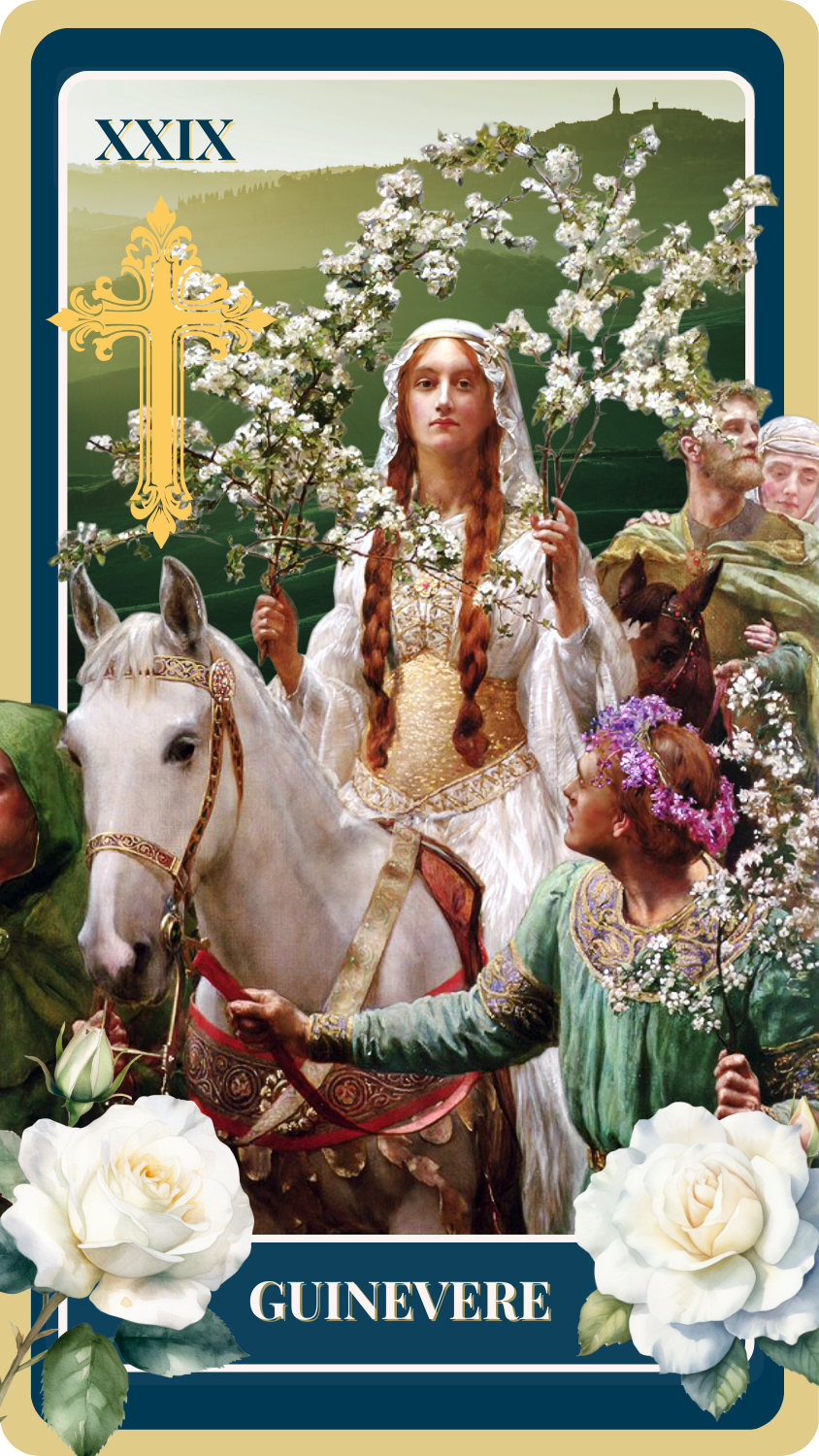
In The Rhetorica, Guinevere is the patron of contested authority.
She governs the space where choice becomes visible, and where the heart and the crown pull in different directions. It’s that space where the consequences of love cannot be delegated to myth.
Writing with Guinevere means refusing to outsource responsibility to fate or villainy. It means standing inside the decision and allowing its weight to be felt.
This is not writing that seeks absolution.
It is writing that accepts consequence as the price of truth.
The story of Guinevere
Guinevere’s story survives largely through accusation. She is remembered as an adulteress, a catalyst, and an excuse.
Yet these labels flatten a far more difficult reality: she is a woman navigating sovereignty in a world that demands her symbolic purity while denying her full humanity.
Her marriage is political, her love is personal, and the collision between the two exposes the fragility of the idealised order around her.
Camelot does not fall because Guinevere loves.
Oh no…it falls because the Kingdom cannot reconcile its ideals with the truth of human desire and divided loyalty.
Guinevere becomes the screen onto which that failure is projected; her body and choices are turned into moral shorthand so the system itself does not have to be questioned.
For writers, her lesson is profound.
There are moments when telling the truth means accepting that you will be misread. That complexity will be punished. That refusing of simplification may cost you approval, belonging, or safety.
Guinevere teaches us that sovereignty is not the absence of conflict, but the courage to remain present within it.
To write with Guinevere is to hold the veil and lift it at the same time.
Symbols + Secrets
White roses
love entwined with obligation; beauty that carries consequence; innocence redefined rather than erased
Holy cross
vows, sacrifice, and the weight of moral law; faith as structure rather than refuge
Veil
what is hidden to survive; what is revealed to remain truthful; the threshold between private knowing and public judgment
Spring
renewal born from rupture; the season after collapse; life that insists on returning despite loss
Creative Prompt: Write the divided choice
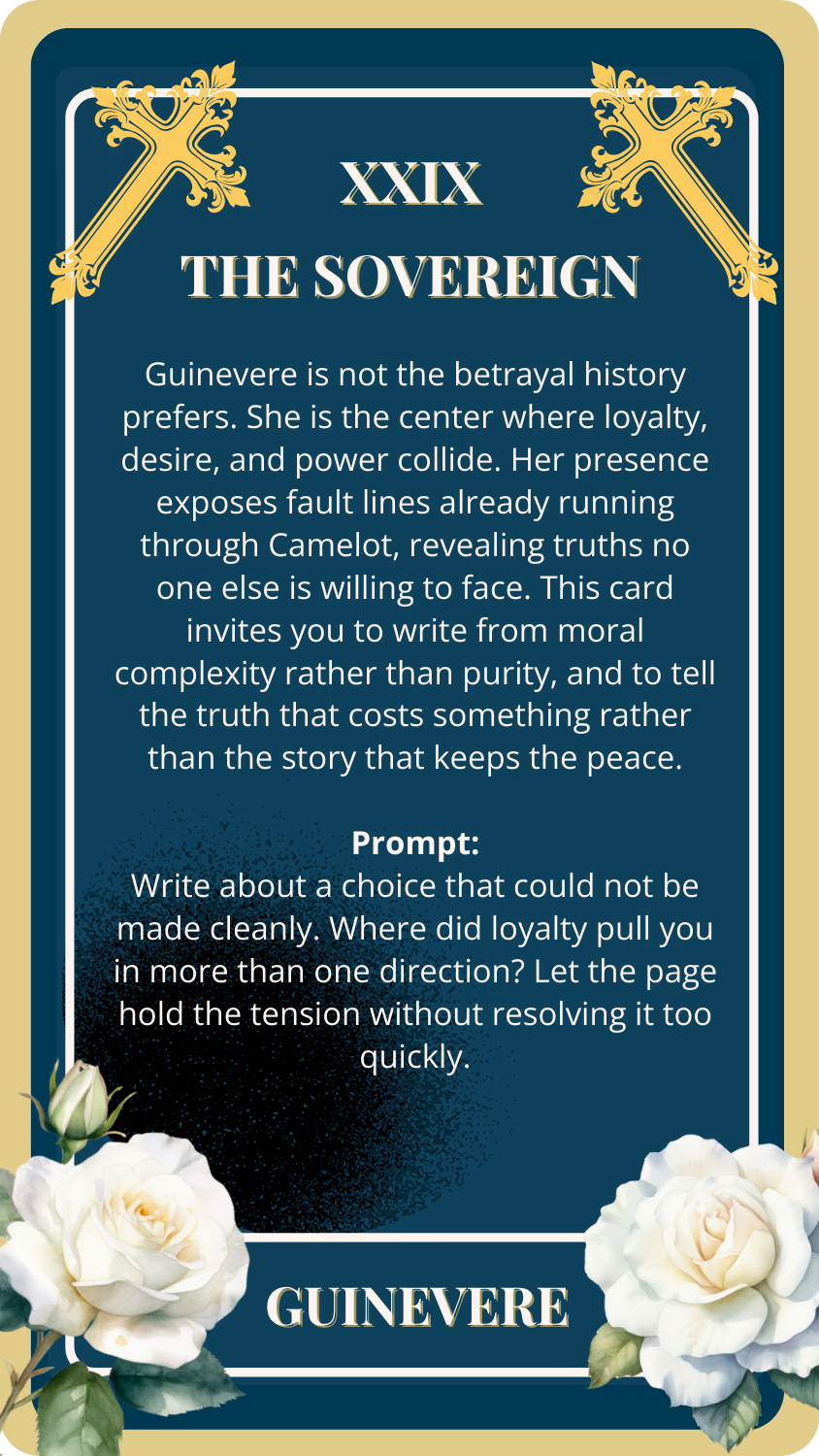
Prompt:
What choice in your life could not be made cleanly?
This week, choose one:
Write about a moment when loyalty pulled you in more than one direction, and no option allowed you to remain innocent.
Write the internal argument you never voiced, letting each side speak fully without resolution.
Write from the moment after the decision, when consequence had already begun to unfold.
Write the truth you withheld in order to keep the peace, and examine what that silence cost you.

Now: let the page hold the tension.
Do not rush toward forgiveness of clarity.
Allow the complexity to remain intact.
How to use this in your business copy
This week: write from sovereignty rather than safety.
Guinevere reminds us that audiences do not trust perfection; they trust discernment. They recognize writing that has wrestled with consequence and chosen honesty anyway.
Try:
“This was not an easy choice, but it was the honest one.” (newsletter opening)
“Here’s where loyalty conflicted with truth…and why I chose truth.” (about page line)
“This work exists because I refused the simpler story.” (sales page positioning)
“I won’t pretend this decision was painless.” (Instagram caption)
When you allow your writing to acknowledge divided loyalties, it gains authority rather than losing it. Complexity signals maturity. Discernment builds trust.
Let your copy wear the crown without pretending it is light.
Let it hold love and consequence in the same hand.
Next week we’ll investigate betrayal and grief.
But for now…
Write like Guinevere:
sovereign, discerning, and brave enough to remain complex.
I've always struggled with Guinevere as a character; thank you for helping me to see her with fresh eyes.