



What if the most powerful act of writing this week is not persuasion, or polish, or performance, but restoration: the deliberate return of complexity to a story that was flattened for convenience?
What if, instead of refining the version of yourself that travels well in public, you wrote from the private chamber of thought—that place where motives are mixed, emotions are layered, and no sentence needs to behave for the crowd?
This is the spirit of Card XXXIII: Marie Antoinette, The Scapegoat.

Marie Antoinette became a symbol before she was understood, and once she had been converted into symbol, spectacle, and shorthand, very few people felt any obligation to recover the person who still existed behind the projection.
Young and foreign in a court built on ritual and surveillance, she was gradually turned into a container for outrage, anxiety, and moral theatre. History, and especially popular history, punished her less for what she demonstrably did than for what others needed her to represent.
This card invites you to write from the place where you, too, have been misread and reduced. It invites you to restore the interior truth that never made it into the loud version of the story.

Card XXXIII: Marie Antoinette
The one who became a myth
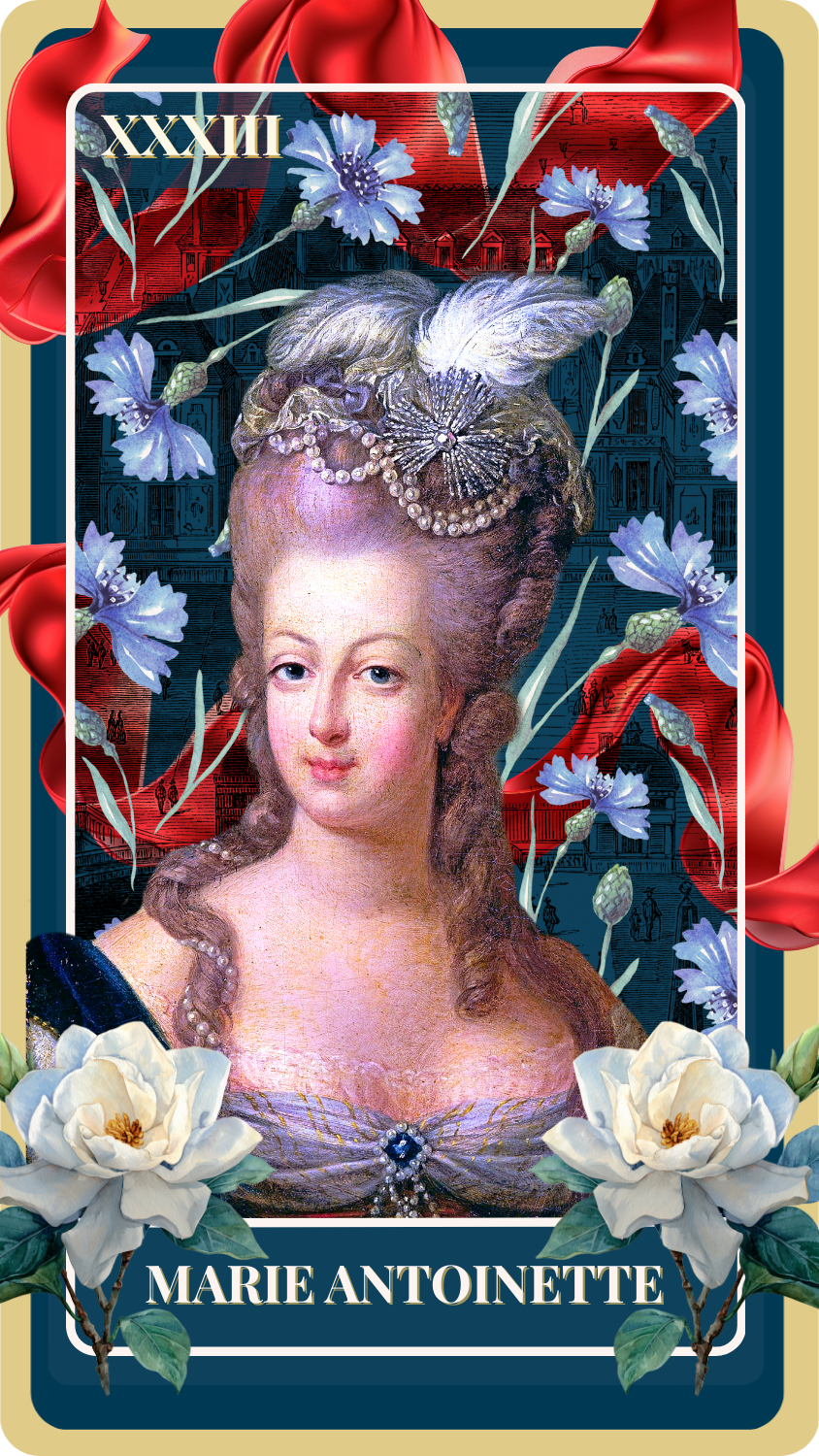
In The Rhetorica, Marie Antoinette stands for narrative substitution: the moment when a living, thinking human being is replaced in the public imagination by a simplified figure that can carry blame more efficiently than truth ever could.
The scapegoat is not selected because the story is accurate, but because the story is useful. Complexity slows accusation down, whereas symbols accelerate it, and public narratives often prefer speed over precision.
To work with this card is to resist narrative reduction in your own pages. It is to notice where a person—including yourself—has been turned into a headline, a trope, a cautionary tale, or a convenient villain…and to reintroduce interiority where the record has grown thin.
This week, you are not writing the visible version of events. You are writing the interior version and the one that unfolded in thought, hesitation, contradiction, and private reasoning while the outer story rushed past.
The story of Marie Antoinette
Marie Antoinette (1755–1793) entered France as a teenage Austrian archduchess, married into a monarchy already strained by debt, factionalism, and deep political unease. From the moment she arrived at court, she was observed as an object of interpretation. Her gestures were decoded, her tastes criticised, her foreignness emphasised long before she held meaningful political influence.
As unrest in France intensified, so too did the appetite for figures who could embody public anger. Pamphleteers, satirists, and propagandists found in the young woman a ready-made character. Exaggerations hardened into accepted facts, invented quotes travelled as truth, and symbolic excess attached itself to her image whether or not it matched her daily reality.
She became a narrative device as much as a queen.
And yet her private correspondence and surviving records reveal a far more intricate inner life: maternal devotion, loneliness, fear, miscalculation, loyalty, and a growing awareness of how precarious her position had become. There is a marked difference between the woman in the letters and the woman in the caricatures.
For writers, her legacy is not a moral but a method: when the outer narrative grows loud and simplified, the inner narrative becomes more necessary. The unwritten interior is often where the truth survives.
Symbols + Secrets
Red velvet
The language of luxury turned into evidence; how texture, beauty, and softness are recast as moral failure when a crowd needs proof of excess
White rose
Innocence debated and denied; reputation placed on trial; the fragile distance between purity as lived and purity as judged
The corn flower
Private loyalty and remembrance; the quiet, personal symbol that survives long after public narratives collapse
The façade of Versailles
Magnificence as mask; curated splendour that conceals strain, fear, and political fracture behind symmetry and gold
The mirrored halls
Distorted reflection and multiplied story; the way perception refracts when too many voices narrate the same figure at once
Creative Prompt: Write the interior
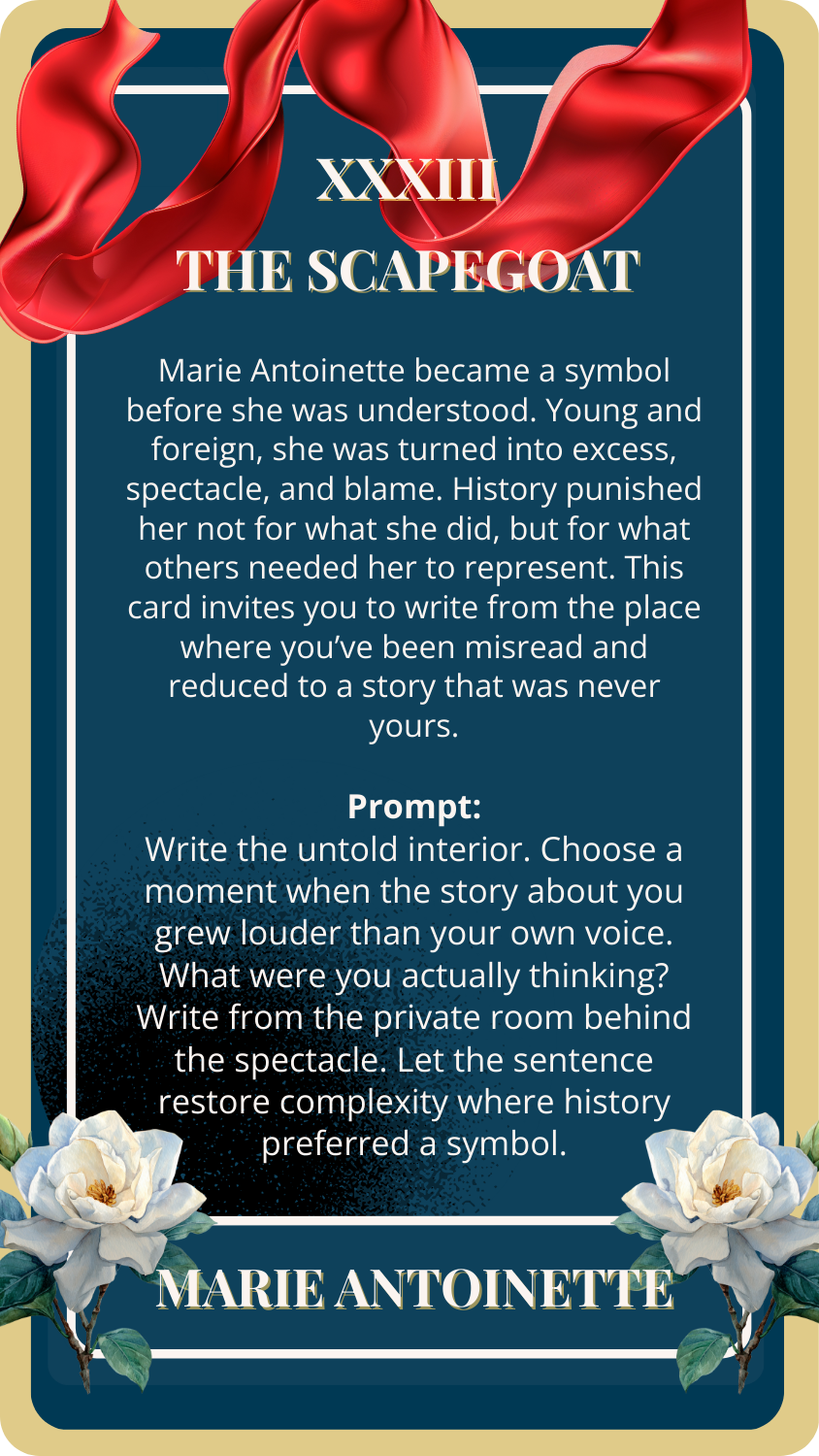
Prompt:
How have you become a story that isn’t you?
This week, choose one:
Write the moment when the narrative about you grew louder than your own voice. What were you actually thinking at the time?
Write a scene in which you were publicly misunderstood, and stay entirely inside your private reasoning rather than the outer reaction.
Write from the instant you realised you were being reduced to a type, a role, or a symbol…and record your true interior response.
Write the “private room behind the spectacle”: the thoughts, doubts, motives, and emotions that never made it into the visible version.

Now: restore complexity.
Let the sentences return nuance where the outer story preferred simplicity.
How to use this in your business copy
This week: write something with dimension
Instead of refining your public-facing story into something smoother, consider making it more dimensional, because credibility is built less from perfection than from articulated interior logic.
When you allow your audience to see the reasoning behind a decision, the tension behind a pivot, or the layered motives behind your work, you replace suspicion with understanding and distance with trust. You are no longer presenting a façade; you are offering a mind at work.
Try:
“This is the part of the story most people never heard.” (newsletter opening)
“Here’s what was actually happening behind the decision.” (about page line)
“The public version is simple. The real version is human.” (sales page positioning)
“I was reduced once. Now I write the full truth.” (Instagram caption)
Clarity of interior motive is persuasive in a way polish alone can never be.
Next week we’ll do magic.
But for now…
Write like Marie Antoinette:
complex, interior, and irreducible..
P.S.
If you enjoyed this or learned something, consider upgrading your subscription. And don’t forget: if you subscribe as a Card Holder, we’ll send you the physical deck of Volume 1 (The Rhetorica) at no extra cost when it published in June!
