



What if your writing understood its own power?
What if every line carried both intellect and allure that was decorative, yes….but also gave direction?
This is the spirit of Card VII: Cleopatra, the Strategist.
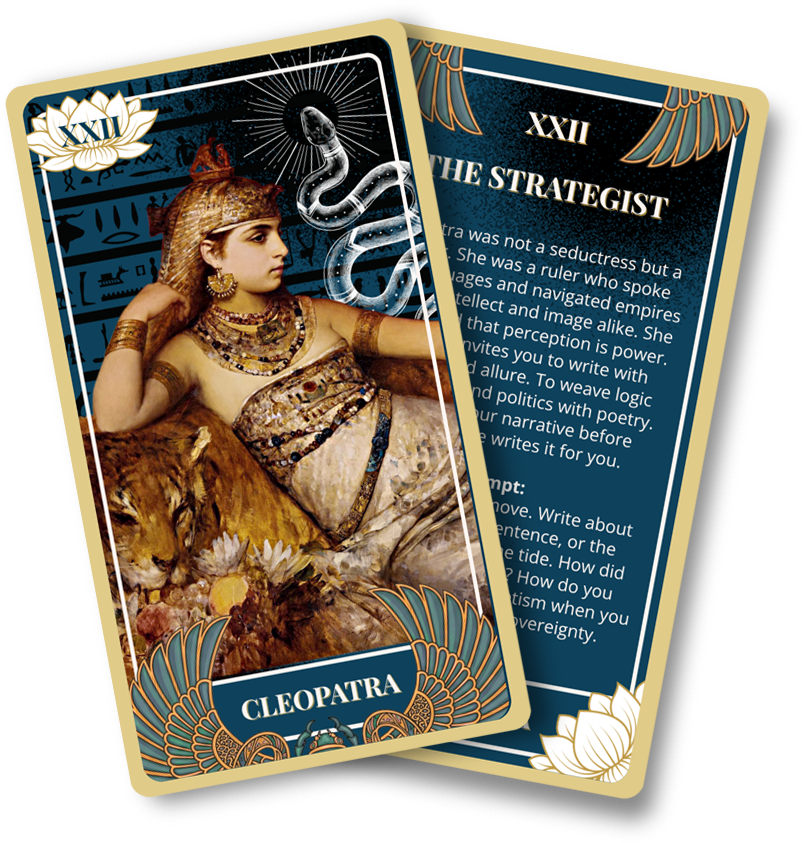
Cleopatra ruled through fluency.
Quite literally, actually, as she spoke nine languages. And she had several modes of influence. A full spectrum of human persuasion: scholarship, ceremony, diplomacy, and the luminous confidence of someone who refused to be spoken for.
She understood that how a story is shaped determines who is believed.
And that narrative, once arranged with intention, is a force capable of outliving empire.
This card is not an invitation to seduce, which we tend to associate with Cleopatra. (We have a long history of placing extreme sexuality onto powerful women!)
Rather, this is an invitation to direct.
It invites you to choose your imagery the way Cleopatra chose her regalia, which is to say: let symbol become strategy and beauty become argument.
In other words: write as if the rumor mill were your court, and you were already on the throne.

Card XXII: Cleopatra
The one who shapes perception
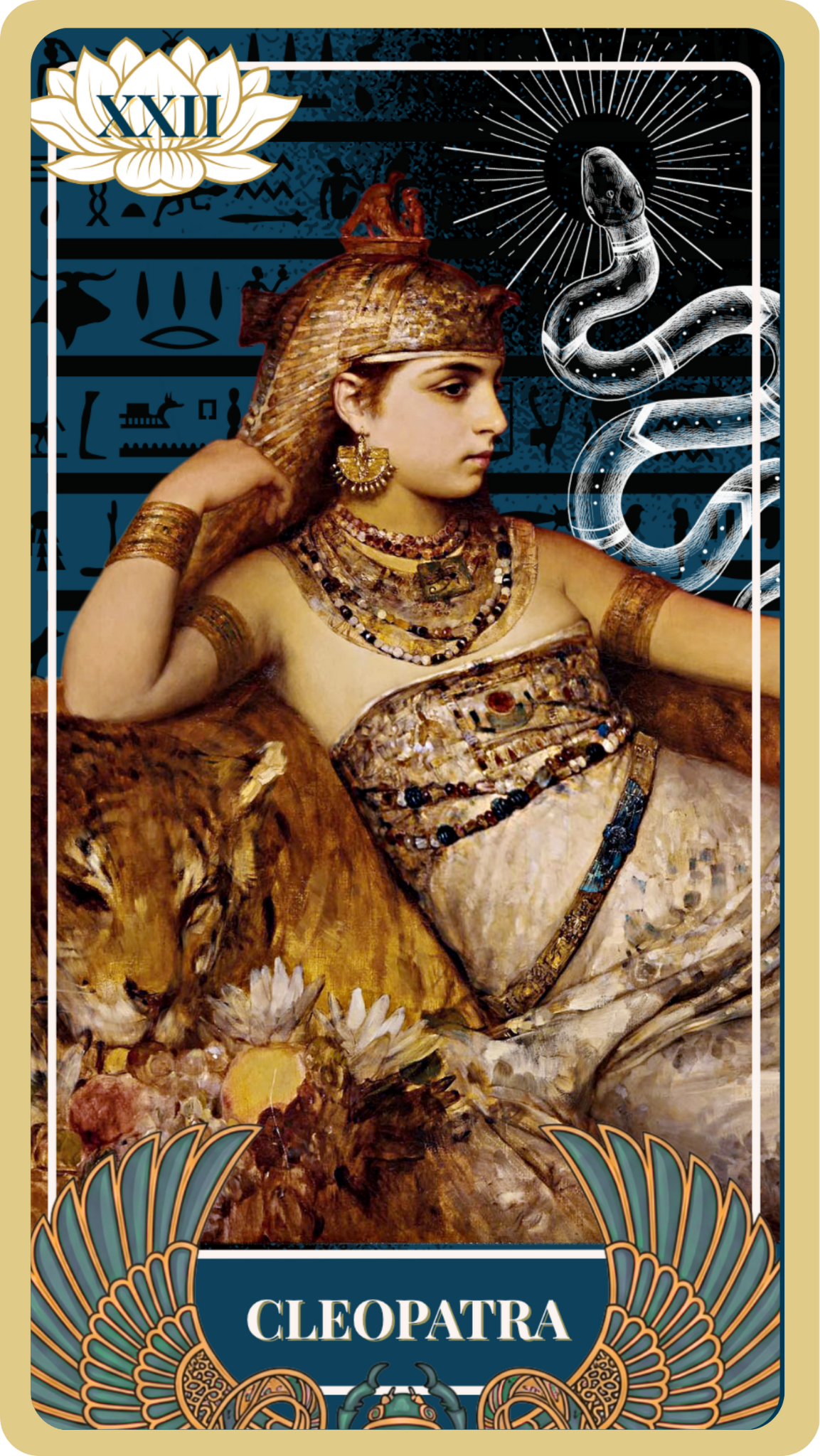
In The Rhetorica, Cleopatra is the patron of narrative command.
She teaches that writing is choreography: a deliberate sequence of tone, detail and silence.
Your audience is always reading the subtext. As such, Cleopatra urges you to own that power and to let your choices speak before your explanation does.
To write with Cleopatra is to treat every sentence as a signifier, every metaphor as a declaration, and every image as a quiet coronation.
This week, you’re not writing passively.
You are writing to reign over your own story.
The story of Cleopatra
Cleopatra VII Thea Philopator (69–30 BCE) was Queen of Ptolemaic Egypt—a Macedonian Greek, who embraced Egyptian heritage in a way her predecessors never cared to do.
She inherited a kingdom knotted with dynastic tension and Roman ambition, and she answered with scholarship sharpened into statecraft.
She studied rhetoric, astronomy, mathematics, medicine, and philosophy. She understood that knowledge is best cultivated as a performance.
Her first meeting with Caesar, arranged as a theatrical unveiling inside a carpet, was strategy rather than seduction. It was an act of narrative control.
Her arrival to Antony on a gilded barge, sails perfumed and musicians playing, was diplomacy rendered as art.
These gestures were rhetoric in motion and bigger than frivolity. They were a way of asserting identity before anyone else could define it.
And beneath the spectacle was clarity.
Cleopatra understood that symbols—the crown of Isis, the lotus blossom, the sacred serpent—spoke across borders and centuries.
She wielded them with exacting intelligence, proving what many writers forget: image is argument.
For writers, her lesson is steady and incisive.
Decide how you want to be understood. Choose a symbol, crown it, and let the rest of your work form constellations around it.
Let your language be deliberate, your silences articulate, and your structure as purposeful as a royal procession.
Cleopatra teaches us: direct the narrative…or someone else will.
Symbols + Secrets
Hieroglyphs
The original language of power; writing as magic; the truth that symbols can speak louder than sentences
The asp
Consequence chosen, not inflicted; the courage to end with agency; transformation that answers only to itself
The lotus
Rebirth, renewal, the mind that surfaces clear after turmoil; beauty as resilience
The tiger
Ferocity in focus; the disciplined strike; the quiet certainty of someone who knows when to wait and when to pounce
The winged scarab beetle
Rebirth through intellect; the mind that lifts itself; the ancient belief that the sun rises because someone willed it to begin again
Creative Prompt: write symbols as strategy
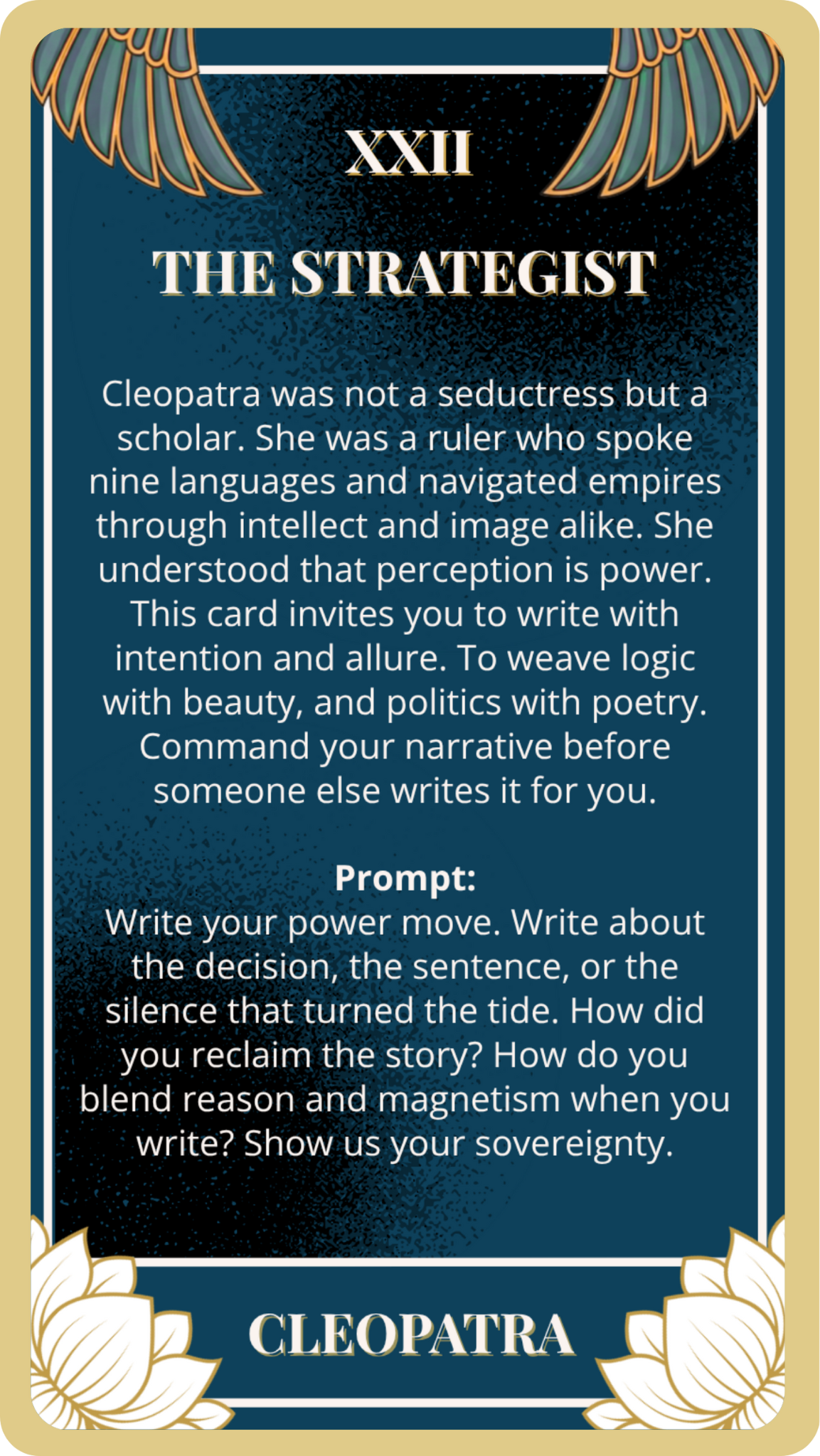
Prompt:
What is your biggest power move?
This week, choose one:
A decision you would make if you trusted your intellect completely.
A sentence that redirects the narrative through precision, not apology.
A silence that asserts itself more clearly than any explanation.
A moment in which you reclaimed the story from someone who tried to define it for you.

Now: write a paragraph that blends symbols and strategy.
Let your imagery be chosen, your cadence intentional.
Write as if your words were carved like hieroglyphs: enduring, decisive, and unmistakably your own.
How to use this in your business copy
This week: shape the story before anyone else does.
When you write like Cleopatra, you stop reacting and instead take the director’s role.
Your message shifts from scattered to sovereign. Tone becomes stance; imagery becomes influence; your voice becomes the architect.
Try:
“Here is the version of the story that endures.” (website hero)
“I choose the narrative—and this is what it means.” (newsletter opener)
“My message doesn’t persuade by chance; it persuades by design.” (Instagram/LinkedIn)
“Let this be inscribed: the heart of my work is…” (sales page subhead)
“I offer clarity, not conjecture—and here’s what follows.” (launch email)
Authority here is not dominance but coherence.
It is the steady signal that reassures your audience where to stand.
Next week we shift from strategy to something wilder.
But for now…
Write like Cleopatra:
strategic, sovereign, and fluent in the language of power.